




Water won’t tell you if it’s safe.
Elkay has filter lights for that.

Odorless. Flavorless. Clear. Harmful toxins in school drinking water are sneaky like that.
The best way to know water is safe from contaminants like lead is to look for filter lights. While many Elkay stations provide filtered water—not every fountain is filtered—even if it seems new. So, look for filter lights on your school’s drinking stations; and if you don’t see them, demand safe, filtered water for your school.
Why is filtering water so important for kids?

Kids need more water than adults.
Their growing bodies are up to 65% water. They need more water because organs like their brains are developing rapidly.
Source: 2023 National Institute of Health

They’re more sensitive to toxins.
They’re still growing. Toxins like lead disrupt growth and can cause learning disabilities, behavioral issues, and more.
Source: 2024 Harvard University Center on the Developing Child

Regulations aren’t protecting them
There are no federal regulations requiring schools to test their water for toxins, and 66% of states don’t mandate it either.
Source: National Association of State Boards of Education / ABC News research
See what’s in your water.
Check out this map or enter your school’s zip code to see what chemicals and toxins your child may be drinking every day, if their water isn’t filtered.
How can you tell a water source is safe?


Look for filter lights.
Filtered Elkay fountains and filling stations have lights that show when filtration is active and when a filter needs to be changed. Don’t see filter lights that look like this? The unit may not be filtering at all. That means kids could be drinking water contaminated with harmful lead, forever chemicals (PFAS), viruses, and more.
Filter Lights =
Safe, Clean Filtered Water
No Filter Lights =
Lead and other toxins could be sneaking into their water
You have the power to protect kids.
Parents and staff can be powerful advocates for safe water in schools—and you don’t have to be a water expert to do it. Elkay has the tools you need to get other parents on board and urge your school officials to take action. Together, we’ll make your voice heard.
- Speak Confidently
- Post on Social Media
- Funding Resources
- Bring It Into the Classroom

Speak Confidently
Just one voice can spark change. Here’s language you can use to address your school board, speak at your PTA meeting, start a conversation with your principal, or talk with the school facilities manager.

Post on Social Media
Use your connections to make other parents aware of water safety issues in their schools. Here are templated social posts you can use.

Need help funding filtration?
Download our funding resources document that gives you a few real paths on how to make it happen.

Bring It into the Classroom
Principals are often the first step in getting schools or districts to act. Here’s a pre-written email you can send.
Elkay Blog
Your Child's School Has a Water Fountain. But Is It Actually Filtering Anything?
By Krystal Pesch, Senior Director, Portfolio Management, Zurn Elkay
I'll be honest. For years, I assumed my kids' school had it handled. Renovated building. Clean hallways. Nice water fountains. Surely someone was making sure the water was safe, right? Then I started working in drinking water, and what I learned changed how I think about every single sip my kids take at school.

Get inspired by real schools making real change.
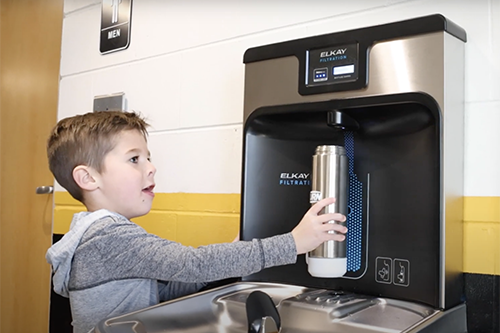
Suburban students teach their principal not all fountains have filters, sparking change.
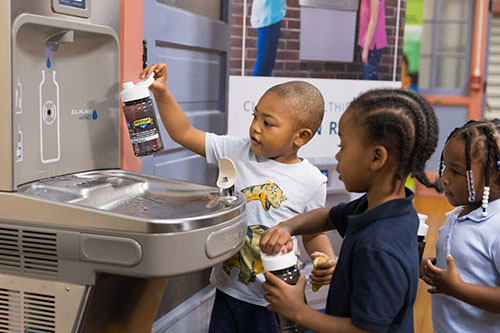
A city struggling with lead finds a district-wide solution.
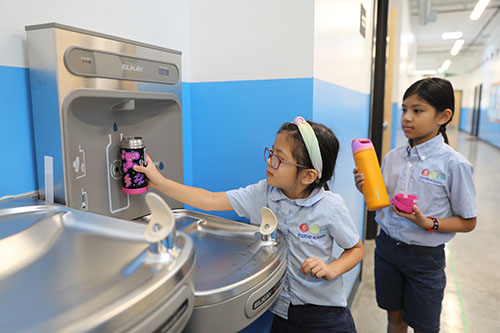
A charter school in L.A. surrounded by old infrastructure protects students.
 Elkay is a proud sustaining partner of Texas PTA
FAQs
No, they don’t. In fact, not even all Elkay school water fountains and bottle fillers have filters. Not every school needs one, because not every school has water contamination issues.
Elkay fountains and bottle filling stations with filters have lights that show filtration is active, the status of filter life, and showing when it needs to be changed. There are several editions of filter lights, green-yellow-red dots, blue dots, and more, but they all mean the same thing—a water station is filtered and safe.
Filtered drinking fountains improve water quality by removing contaminants (like lead, chlorine, and bacteria), enhancing taste and odor, and encouraging better hydration—especially valuable in schools. They also reduce plastic waste by promoting reusable bottles. Unfiltered fountains, on the other hand, can expose users to contaminants from old, potentially lead pipes, unpleasant tastes or odors, and bacteria buildup on surfaces. Ultimately, filtered fountains are the safer, more reliable option for health and taste, particularly in older buildings or areas with questionable water quality.
Yes. Elkay offers filter retrofit kits that can be added to many existing Elkay water delivery products. The EWF3000 Filter System Kit converts a non-filtered bottle filler into a filtered unit. The EWF172 Filter System Kit converts a non-filtered cooler or fountain into a filtered unit.
Yes, many Elkay filtration products are NSF/ANSI 42 and 53 certified. That means they filter for taste, odor, and color caused by chlorine manganese, iron, zinc, and large particles. They can also filter for serious health-related contaminants such as lead, microplastics, forever chemicals (PFOA and PFOS* ) and more.
* https://helpcenter.elkay.com/s/article/NSF-ANSI-53-Certification
Search for your school’s zip code at https://www.ewg.org/tapwater/ to see the water quality issues in your area. Then check to see if your school’s fountains and bottle filling station have filter lights.
Exposure to lead in water is extremely harmful to kids. It can slow brain development, causing developmental delays, learning disabilities, and behavioral issues. Kids exposed to high levels of lead may have problems learning and reading, and experience delayed growth and hearing loss. At very high levels, lead can cause permanent brain damage and in rare cases, death.
Well, it’s hard to say because there are no federal regulations requiring schools to test their water quality. And there are only 17 states that mandate school water testing. So, we’re relying on the schools who voluntarily test their water for data. There are also SOME testing requirements for a very small number of schools nationwide who have their own water systems (such as a well). In a 2023 analysis of 7,758 schools with their own water systems, 77% of them had some level of lead in their water.