
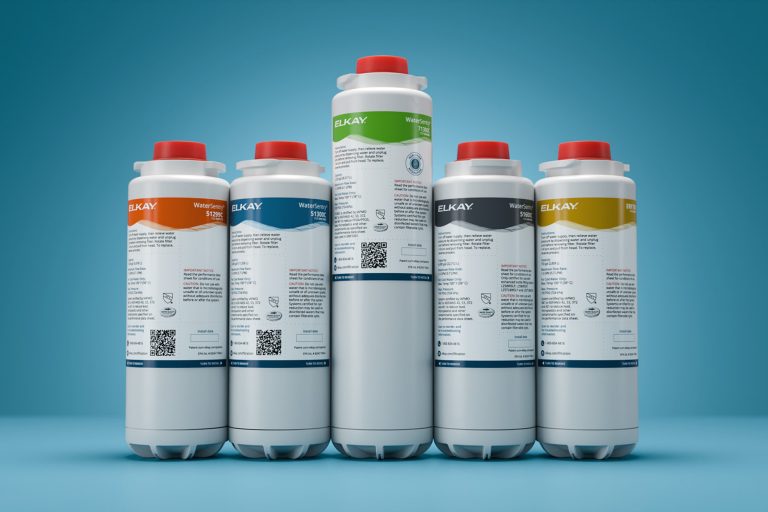
If you’ve ever looked at a water filter package, you’ve probably seen a string of numbers like NSF/ANSI 42, 53, 58, 61, 372 or 401. At first glance, they can look like different versions of the same certification, but each standard addresses something different, from improving taste and odor to reducing specific contaminants in your water. Understanding the difference can help you figure out what a filter is actually certified to do.
What Does “NSF/ANSI” Mean?
NSF originally stood for the National Sanitation Foundation. Today, it refers to NSF International, a public health and safety organization that develops public-health standards and operates certification programs for products that come into contact with drinking water, food and other consumer products.
ANSI, the American National Standards Institute, accredits the consensus process used to develop many of these standards. When you see NSF/ANSI followed by a number, you’re looking at a specific standard that defines testing requirements and performance criteria.
There’s one important detail to understand: Being certified to a standard doesn’t mean a product is certified for everything covered by that standard.
For water treatment product standards, certification is generally claim-specific and model-specific. Think of the standard as a menu of possible claims. A product’s certification listing tells you which contaminant reduction claims actually apply to that specific product. That distinction is especially important when you’re shopping for a filter.
NSF/ANSI 42: Taste, Odor and Other Aesthetic Effects
NSF/ANSI 42 addresses contaminants and characteristics that affect the taste, smell, appearance or other aesthetic qualities of drinking water. Common claims include reduction of:
- Chlorine taste and odor
- Particulates
- Other substances that affect the aesthetic quality of water
A filter certified only to NSF/ANSI 42 is not necessarily certified to reduce health-related contaminants such as lead or PFAS.
If your water is safe to drink but you don’t like the taste or smell, an NSF/ANSI 42 water filter may be exactly what you’re looking for. Just remember, better-tasting water and contaminant reduction are not the same.
NSF/ANSI 53: Health-Related Contaminant Reduction
NSF/ANSI 53 addresses specific contaminants that may have a health effect when present in drinking water. Depending on the product and its certification, this can include claims for contaminants such as:
- Lead
- Mercury
- Asbestos
- Certain volatile organic compounds (VOCs)
- Cysts, including organisms such as Giardia
- PFOA and PFOS
- Other specifically named contaminants
Broader PFAS claims, including Total PFAS, are also beginning to appear in NSF/ANSI 53 listings. NSF/ANSI 53 is not a blanket certification for every contaminant that can affect health. A product certified to NSF/ANSI 53 is certified for the specific claims listed for that product.
If you’re concerned about lead, look for a specific lead-reduction claim. If PFAS is your concern, look for the specific PFAS claim. Simply seeing “NSF/ANSI 53” on a package doesn’t tell you which contaminants the filter reduces.
NSF/ANSI 53 is the standard to pay close attention to when you have a specific contaminant concern, whether that’s lead, PFAS, VOCs or another contaminant. You’ll also often see NSF/ANSI 42 and 53 together on the same product. That means the filter may have both aesthetic and health-related reduction claims.
NSF/ANSI 58: Reverse Osmosis Systems
NSF/ANSI 58 applies specifically to reverse osmosis (RO) drinking water treatment systems. These systems are evaluated for things such as total dissolved solids (TDS), along with other optional contaminant-reduction claims depending on the specific model. Those claims can include contaminants such as fluoride, nitrate and certain PFAS compounds.
RO can be useful when you want to reduce a broad range of dissolved contaminants or specifically need TDS reduction. There are some tradeoffs to consider, too. RO systems typically:
- Take up more space
- Produce some wastewater during the filtration process
- Operate more slowly than many conventional filtration systems
- Remove minerals along with other dissolved substances
- Whether those tradeoffs make sense depends on what you want your water treatment system to accomplish.
NSF/ANSI/CAN 61: Health Effects of Drinking Water System Components
NSF/ANSI/CAN 61 evaluates materials and components that come into contact with drinking water to determine whether they could impart potentially harmful chemical contaminants or impurities into the water.
It can apply to a wide range of drinking water components, including treatment products, filter media, pipes, fittings, faucets and other plumbing components. Think of NSF/ANSI/CAN 61 as being about what the product may contribute to the water, rather than what the product removes from the water.
NSF/ANSI/CAN 372: Lead content in materials
NSF/ANSI/CAN 372 addresses the lead content of materials used to make a product. It helps verify that the product is made with materials that meet applicable low-lead requirements. It does not mean the filter removes lead from water. This is an easy distinction to miss: 372 is about what the product is made of, not what it removes.
NSF/ANSI 401: Emerging contaminants
NSF/ANSI 401 addresses a defined group of emerging or incidental contaminants, including certain pharmaceuticals, pesticides, herbicides and chemical compounds.
Even though PFAS is often discussed among “emerging contaminants,” NSF/ANSI 401 is not a PFAS certification. If PFAS reduction is your goal, don’t assume that an NSF/ANSI 401 certification means the filter has been certified for this purpose. Look for a specific PFAS claim in the product’s certification listing.
NSF/ANSI 401 can provide additional contaminant-reduction coverage, often alongside other certifications such as NSF/ANSI 53.
Certification Covers More Than Contaminant Reduction
There’s another part of NSF/ANSI certification that’s easy to overlook. Standards such as NSF/ANSI 42, 53, 58 and 401 include requirements for things like materials, product design and construction, in addition to the specific performance claims associated with each standard.
These requirements help ensure that certified products are designed and constructed appropriately for their intended use. They can include requirements related to materials safety, such as limited the potential for harmful substances to be introduced to drinking water, as well as physical performance testing, including pressure and life-cycle testing where applicable.
So when you see an NSF/ANSI certification, it’s not simply a statement that a filter reduces a particular contaminant. The product also must meet the applicable requirements of the standard for how it is made and how it performs.